
Pokémon FireRed Review: Is It Still Worth Playing?
Yes, for most players. Pokémon FireRed, released for the Game Boy Advance in 2004, remakes the original Pokémon Red and brings the Kanto experience to the Ruby and Sapphire engine. It keeps the simplicity that made the 1996 game successful, adds abilities, natures, and a proper help system, and gives you a new post-game area in the form of the Sevii Islands. Its major flaw is its age; battles are slow, HMs take up move slots, and you can’t complete the Pokédex without trading. This Pokémon FireRed review is based on a comprehensive editorial evaluation of the game’s documented features and critical reception. The short of it: it’s a great first Pokémon game and the cleanest way to play old Kanto, but modern Pokémon players should expect some friction.
Pokémon FireRed Review: Quick Verdict
| Original platform | Game Boy Advance |
| Genre | Turn-based role-playing game |
| Developer / publisher | Game Freak / Nintendo (The Pokémon Company in Japan) |
| Original release | January 29, 2004 (Japan); September 7, 2004 (North America) |
| Main gameplay focus | Catching, training, and battling across Kanto |
| Strongest feature | A focused, well-paced Kanto journey with Gen 3 battle depth |
| Biggest drawback | Slow battles, HM clutter, and trade-locked Pokédex completion |
| Best suited for | First-time players and fans of classic Pokémon |
| Final recommendation | Worth playing, with realistic expectations |
What Is Pokémon FireRed?
FireRed and its companion LeafGreen are Game Freak’s remakes of the first-generation titles, Red and Green in Japan and Red and Blue elsewhere. They use a tweaked version of the Ruby and Sapphire engine, so the original 151 Pokémon get third-generation mechanics. The remake sold about 12 million copies on GBA, and it received an 81 on Metacritic from 38 critics. On February 27, 2026, it was re-released on Nintendo Switch and Switch 2 as a standalone $19.99 eShop download. For a feature-by-feature overview, see the Pokémon FireRed Version guide on ROMSFUN.
Story and Kanto Adventure
The story is thin. Mostly, that’s ok. You leave Pallet Town, collect eight Gym badges, run into your rival a lot, and stop Team Rocket’s schemes in Celadon City and Saffron City at Silph Co.
It’s well put together. Kanto is tight, the routes make sense, and each Gym Leader tests what you’ve been preparing for. FireRed also adds a Fame Checker to keep track of what you learn about characters, giving the cast a little more personality than the original. There’s not much here for story-driven players, but the road to the Elite Four still feels like progress.
Pokémon FireRed Gameplay and Battle Mechanics
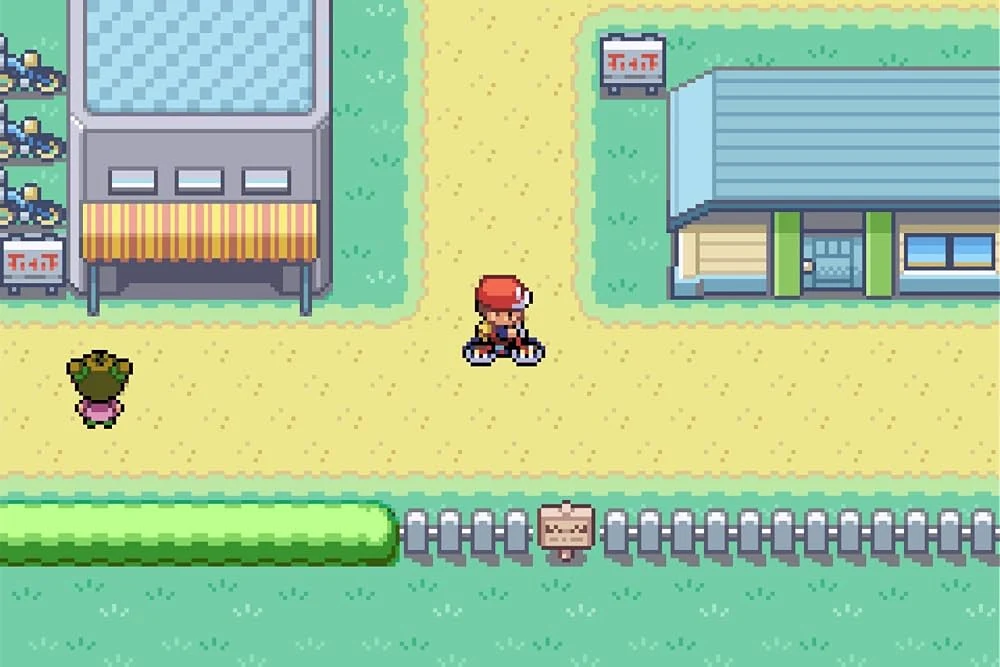
The core loop is simple: travel a route, battle trainers, catch new Pokémon, and reach the next town. Turn-based fights are primarily decided by type matchups.
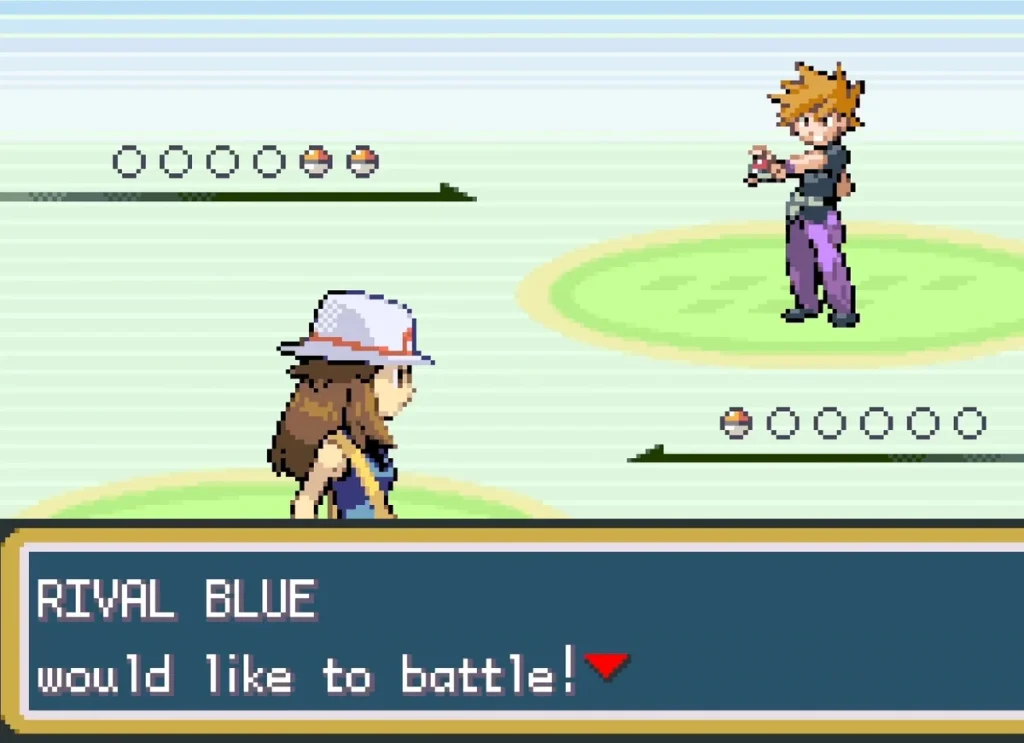
The Gen 3 engine makes those fights deeper than they were in Red and Blue. Items held provide another layer. Abilities and natures give Pokémon of the same species varied powers. You can re-battle trainers on routes with the Vs. Seeker, which can be helpful for training. One difference veteran players will notice is that a move’s type determines whether it is physical or special in this generation. All Fire, Water, and Electric attacks are special; thus, a strong physical Pokémon like Gyarados cannot employ its highest stat with its Water attacks.
Strategy is rewarded, but it also lets you over-level one strong Pokémon, which is forgiving for beginners and less demanding for veterans.
Pokémon Variety and Team Building
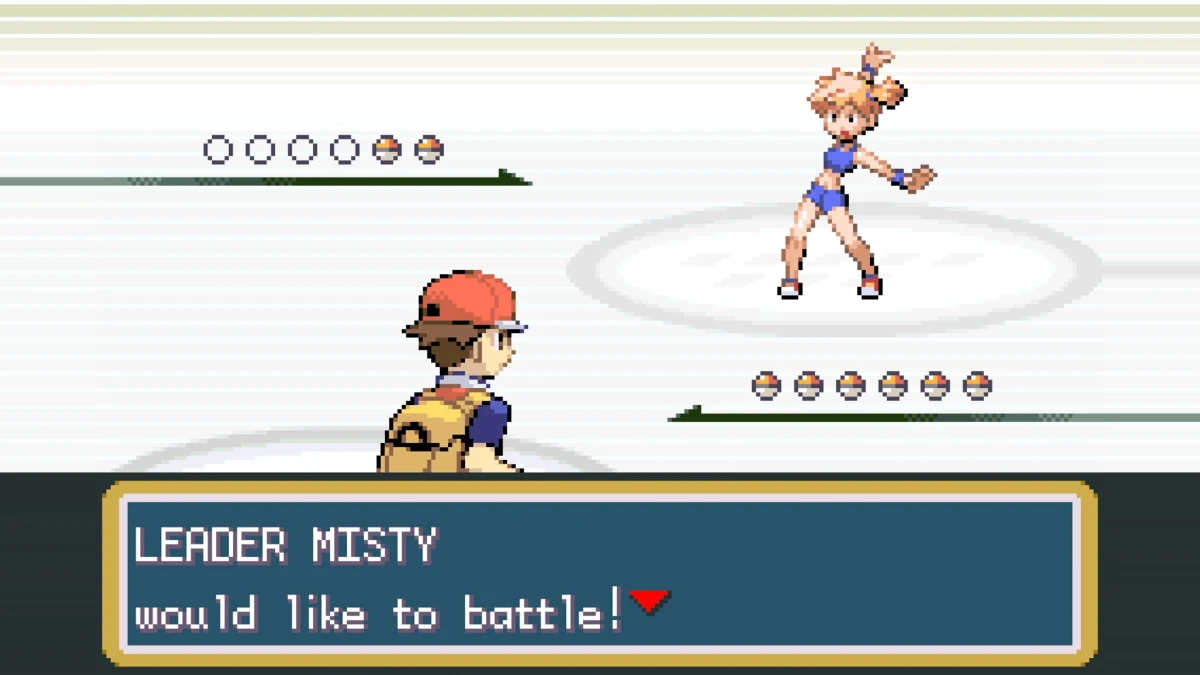
Your beginning decision determines your opening. Bulbasaur makes the first two Gyms a breeze, while Charmander starts rougher against Brock’s Rock types and Misty’s Water types. The rest of the main game offers mostly the original 151 Pokémon, with Johto Pokémon added in the Sevii Islands.
That pool supports multiple teams, but you can get through much of the game with a single strong Pokémon. FireRed and LeafGreen also divided their exclusives. FireRed has Growlithe, Scyther, Electabuzz, Ekans, Oddish, Psyduck, and Shellder, among others. LeafGreen has Vulpix, Sandshrew, Bellsprout, Slowpoke, and Staryu. If you want one of those, you gotta swap.
Graphics, Music, Controls and Interface
The sprites in FireRed are bright and clear, a considerable step up from the 1996 originals, yet even in 2004 critics still called them basic—Go Ichinose rearranged the music.
The game’s age shows in the interface. You click through many text boxes, menus take multiple steps, and fight animations slow the game down. On the good side, FireRed introduced a help menu and a summary of your last actions when you continue a save, making it easier to pick up after a break.
Difficulty, Pacing and Progression
The early routes are easy, and the only real challenge is from type matchups at some Gyms and the Elite Four. If you train a balanced squad, you won’t need to grind much, but if you rely on only one or two Pokemon, you might want to level up before the league.
A few spots lag the pacing. HMs like Cut, Surf, and Strength take up move slots, and you’ll often need another Pokemon to carry HMs. Rock Tunnel is also slow without the Flash HM.
Sevii Islands, Post-Game Content and Replayability
FireRed’s main addition is the Sevii Islands. You visit the first 3 islands throughout the main story; the others come after you beat the Elite Four. They add additional routes, Johto Pokémon, a Day Care for breeding, and a Team Rocket sub-plot.
After the credits, Professor Oak will update your Pokédex to the National Pokédex if you have seen at least 60 Pokémon. Raikou, Entei, or Suicune roam Kanto depending on your starter, Mewtwo hangs out in Cerulean Cave, and you can rematch the Elite Four with better teams. You need trades from LeafGreen, Ruby, Sapphire, or Emerald to complete the Pokédex.
Pokémon FireRed Pros and Cons
| What we like | What could be better |
|---|---|
| Clear, focused progression through Kanto | Slow text and battle animations |
| Gen 3 mechanics add real strategy | Physical/special split by type limits some Pokémon |
| The Sevii Islands extend the adventure | HMs take up move slots |
| Help menu and save recap for beginners | Version exclusives and trade-locked Pokédex |
Pokémon FireRed vs. LeafGreen and Modern Pokémon Games
FireRed and LeafGreen have the same story, map, and features. The only real difference is the exclusive Pokémon, so choose the one with the Pokémon you like best.
FireRed is slower and less forgiving than modern Pokémon games. Recent games default to giving experience points to your full squad and skip many of FireRed’s menus. Pokémon Let’s Go, Pikachu! and Let’s Go, Eevee! (2018) also rebuilt Kanto but with simplified catching and no wild battles. If you want old-school battling, FireRed is still the superior option.
The 2026 Switch release preserves the original GBA game. It adds local wireless trade and combat, but lacks internet play and suspend saves. It also includes event tickets for Birth Island and Navel Rock, home to Deoxys, Ho-Oh, and Lugia. Since October 7, 2026, Pokémon HOME can receive Pokémon from it, and completing the Pokédex unlocks a Celebi gift in HOME. Transfers are one-way. Not every classic gets this treatment: Ocarina of Time is getting a full Switch 2 remake instead, which we cover in our Ocarina of Time review.
Is Pokémon FireRed Worth Playing in 2026?
- First-time players: yes. Its structure is easy to follow, and the help menu explains the basics.
- Strategy-focused RPG players: maybe. Team building matters, but over-leveling one Pokémon still works.
- Returning fans: yes, mainly for the Sevii Islands and Gen 3 mechanics that weren’t in Red and Blue.
- Completionists: only if you can trade with LeafGreen and a Hoenn game. On Switch, Ruby, Sapphire, and Emerald aren’t available, so you can’t currently get the full National Pokédex there.
- Casual players: yes, especially on Switch, though slow battles can stretch short sessions.
- Modern Pokémon fans: maybe. Expect older menus, but you get a more focused, traditional journey.
Final Verdict
The most crucial thing Pokémon FireRed gets right is making Kanto easy to explore and enjoyable to complete. Gen 3 mechanics and the Sevii Islands add more depth and length than Red and Blue, yet the structure still works for beginners. It displays its age in slow bouts, HMs, and trade-locked completion. If you want a classic, focused Pokémon journey, FireRed is well worth your effort. If you want modern comforts, a recent Pokémon game is a better fit.
Frequently Asked Questions
Is Pokémon FireRed still worth playing?
Yes. Its framework and Gen 3 concepts are solid; however, the battles and menus are slower than in recent games.
Which console was Pokémon FireRed originally released on?
2004, The Game Boy Advance. It was re-released for Nintendo Switch and Switch 2 in February 2026.
How long does it take to finish Pokémon FireRed?
The main story is about 25-30 hours, with more time needed for the Sevii Islands and post-game. Times depend on how you play.
What is the difference between Pokémon FireRed and LeafGreen?
Only Pokémon that are version-exclusive. The tale, map, and features are identical.
Is Pokémon FireRed beginner-friendly?
Yeah. It contains a help menu, a clear path through Kanto, and an easy early difficulty.
Can you complete the Pokédex in Pokémon FireRed alone?
No. To finish your Pokédex, you’ll need to exchange with LeafGreen and either Ruby, Sapphire, or Emerald. Unfortunately, you can’t get the full National Pokédex on Switch, since the Hoenn games aren’t available on that platform.
How does Pokémon FireRed compare with modern Pokémon games?
It’s slower and less convenient, but it’s a more traditional, focused journey.