
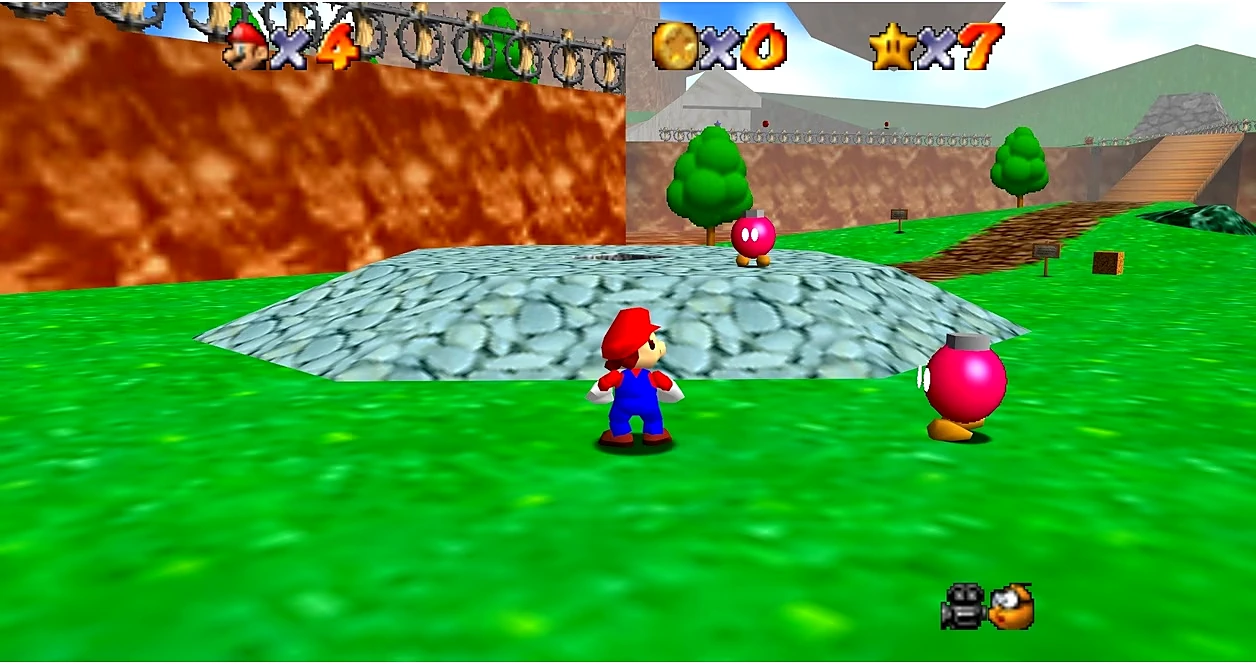
Super Mario 64 Review: Is It Still Worth Playing Today?
Super Mario 64 debuted alongside the Nintendo 64 in Japan in June 1996, and it arrived in North America in September. It showcased how a character might run and jump and explore in three dimensions with freedom, and many of its principles still influence 3D platformers.
This Super Mario 64 review poses a practical question: Is it worth playing, not just remembering? The short answer is yes. The camera and a couple of missions show their age, but Mario’s movement and the game’s tight, secret-filled locales still stand up.
Quick verdict
- Play it if: you enjoy platformers, game history, or mastering tricky movement.
- Skip it if: you have little patience for an old-fashioned camera.
- Best way to play today: Nintendo 64 – Nintendo Classics on Nintendo Switch, with a Nintendo Switch Online + Expansion Pack membership.
Super Mario 64 Quick Facts
| Detail | Info |
|---|---|
| Original release | June 1996 (Japan), September 1996 (North America), March 1997 (Europe) |
| Platform | Nintendo 64 |
| Developer and publisher | Nintendo |
| Genre | 3D platformer |
| Goal | 120 Power Stars across 15 main courses; 70 needed to finish |
Gameplay: Why Mario’s Movement Still Feels Great
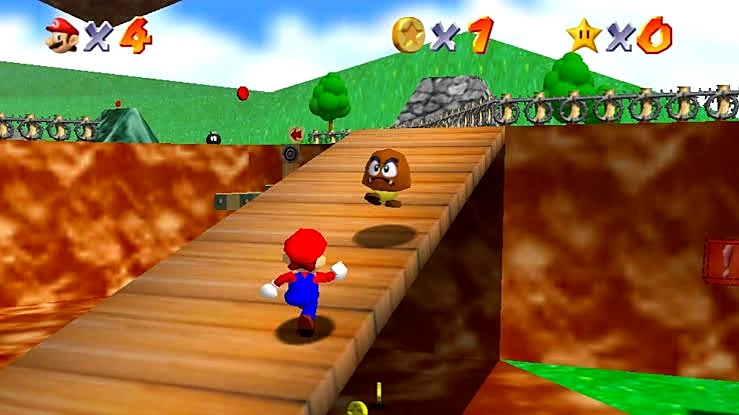
Movement is why Super Mario 64 still works. Mario can also triple leap, long jump, backflip, side-somersault, wall-kick, ground pound, swim and dive, and the analogue stick adjusts his speed from a slow tiptoe to a full sprint.
When these elements come together, the Super Mario 64 gameplay is great. A side somersault into a wall kick can get you to a ledge that the course expects you to climb the long way round. The game seldom penalises the shortcut. It is part of the design to try out.
Also, momentum matters. Every landing feels muscular since Mario takes a second to pivot at speed, and you slide when you reverse forcefully. You have to get used to it, and then it is rewarding in itself.
Level Design, Exploration and Power Stars
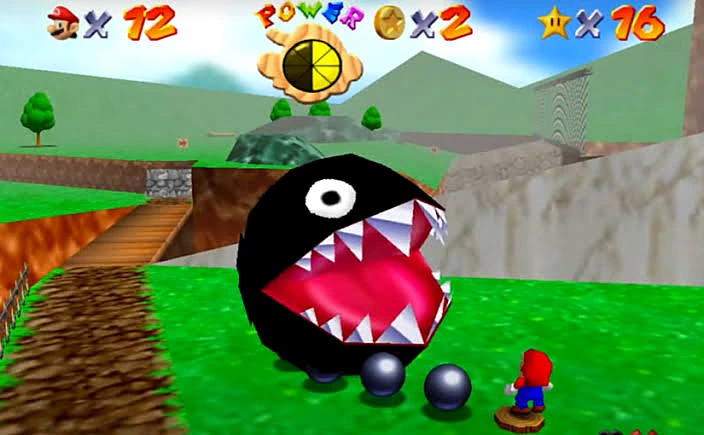
The hub is Princess Peach’s Castle. Paintings unlock 15 main meals. Every time you add to your star count, a new door opens. There are also undiscovered levels hidden in the castle, so investigating the centre itself can be worthwhile.
Each course has a few Power Stars, and each wants you to look at the same region in a new way: achieve a summit, race an opponent, find red money, or scour a corner you skipped. Whomp’s Fortress makes platforming vertical. In Wet-Dry World, how high you jump into the painting dictates the height of the water level. In Tick Tock Clock, the equipment is in a varied state based on the time of clock you enter.
The structure is big. You need only 70 of the 120 stars to finish,h so a frustrating task may wait. The trouble is clarity – a few star names give little clue what to accomplish.
Graphics, Music and Presentation
The graphics are rather basic by today’s standards, with blocky outlines, hazy textures and distant fog. But within the confines of N64 hardware, the strong colours and crisp shapes keep every course easy to read, which is important in a game requiring precise jumps.
The best thing about the presentation is the soundtrack by Koji Kondo. Many still know the cheerful main theme, the quiet Dire, Dire Docks music, and the tense Bowser stages. The clearest evidence that a TV is old on a new TV is the 4:3 picture and low resolution.
The Camera, Controls and Difficulty
For modern players, the major concern is the camera. The game treats it as a Lakitu recording Mario, and you control it with the C buttons, but it swings at weird angles, catches on walls, and has a hard time in confined rooms. It’s a huge difference when you get to modern platformers with a free camera on a second stick.
Difficulty increases gradually. Early levels are gentle, while later levels such as Rainbow Ride require precise jumps over long falls. Most of the annoyance comes from assessing depth on tiny platforms, the camera flipping around mid-jump, and 100-coin stars that reset when you lose a life. Most of it is solved by setting the camera before every perilous jump.
What Holds Up and What Doesn’t
| Holds up | Shows its age |
|---|---|
| Deep, responsive movement | Camera that needs constant adjusting |
| Compact, secret-filled courses | Vague hints for some stars |
| Freedom to choose which stars to chase | 100-coin stars that reset on death |
| Memorable music | Low-resolution 4:3 visuals |
Is Super Mario 64 Worth Playing in 2026?
Yes, if you’re a fan of platformers. You can get to the end without collecting all the stars, and the controls are deep enough that many still speedrun it.
Who will enjoy it
- Platformer fans who like mastering a moveset.
- Returning fans, who will find the worlds smaller than they remember but sharper.
- Players curious about how 3D games developed
Who might not
- Anyone who dislikes searching for vaguely described goals.
- Players who expect a modern camera and frequent checkpoints.
How to Play Super Mario 64 Today
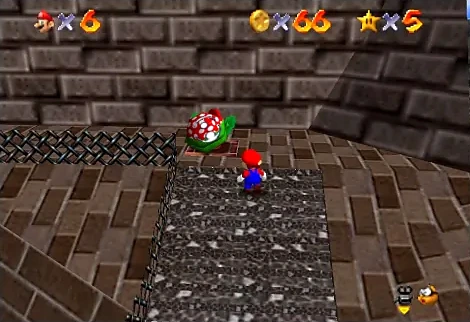
- Nintendo Switch: Super Mario 64 is included in Nintendo 64 – Nintendo Classics, which needs a Nintendo Switch Online + Expansion Pack membership.
- Original hardware: a Nintendo 64 console and cartridge give the authentic experience.
- Super Mario 64 DS: the 2004 Nintendo DS remake adds Luigi, YYoshii, and Wario as playable characters. It is a different version with different controls.
If you’re looking for more information about the game, visit our Super Mario 64 game page for related details and information. Super Mario 3D All-Stars on Switch also included the game, but it was only sold for a limited time.
Super Mario 64 FAQ
How many stars are in Super Mario 64?
There are 120 Power Stars, and 70 are needed to finish the game.
Can you play Super Mario 64 on Nintendo Switch?
Yes. It’s part of Nintendo 64 – Nintendo Classics, available with Nintendo Switch Online + Expansion Pack.
Is Super Mario 64 DS the same game?
No. It’s a 2004 remake with extra playable characters, more stars, and different controls.
Final Verdict
Super Mario 64 isn’t flawless. Its camera is from 1996, and some missions might explain themselves better. But its movement, its tiny worlds,s and its ability to experiment still feel new, making it a game to play, not just read about.
Review summary
- Game: Super Mario 64
- Original platform: Nintendo 64
- Genre: 3D platformer
- Best feature: Mario’s movement and open-ended courses
- Main drawback: Dated camera controls
- Verdict: Still worth playing, especially through Nintendo 64 – Nintendo Classics on Switch.