
Super Metroid Review: Is This SNES Classic Still Worth Playing?
Super Metroid: Game Overview
| Detail | Information |
|---|---|
| Platform | Super Nintendo Entertainment System |
| Released | March 19, 1994 (Japan); April 18, 1994 (North America); July 28, 1994 (Europe) |
| Developer | Nintendo R&D1 with Intelligent Systems |
| Publisher | Nintendo |
| Director | Yoshio Sakamoto |
| Music | Kenji Yamamoto and Minako Hamano |
| Play it today on | Nintendo Switch Online (SNES library), also playable on Switch 2 |
Super Metroid is the third in the series, following Metroid on the NES and Metroid II: Return of Samus on Game Boy. Space pirate leader and Bounty hunter Samus Aran returns to the planet Zebes after Ridley, the Space Pirate leader, steals the last remaining Metroid from a research station. Critics praised it at launch, with Electronic Gaming Monthly naming it its Game of the Month and Nintendo Power saying it “may well be the best action-adventure game ever.” Sales were reasonable, not spectacular, reaching about 1.42 million copies worldwide by 2003, according to estimates published on Wikipedia.
A World Built Around Exploration
Zebes is not a set of levels; it is one connected map” and “a real place worth learning. Crateria, Brinstar, Norfair, the Wrecked Ship, Maridia, and Tourian all flow into each other through elevators, shafts, and closed doors, and the game rarely tells you where to go next. Instead, it shows you locations you can’t get to yet and trusts you to remember them.
And that trust is the nature of the game. Once you have the Hi-Jump Boots, a high ledge becomes a target. After you collect Super Missiles, the green door you walked past earlier becomes your next stop. Every upgrade quietly redraws the map in your head. The best moments come when you realize, without being told, that a new ability solves a problem from way earlier.
The auto-map is what makes this possible. Previous Metroid games let players draw their own maps; here, the pause screen fills in while you play, and map stations disclose entire regions ahead of time. That makes getting lost into a puzzle, not a chore.
Gameplay, Combat and Samus’s Abilities
Samus starts out with nearly nothing: a short-range beam, a jump, and the ability to run. Ultimately, she can get around Zebes very freely. The Grapple Beam lets her swing across gaps, the Speed Booster lets her smash through walls while running, the Space Jump lets her stay airborne forever, and the X-Ray Scope reveals hidden blocks.
Most upgrades affect Samus’ movement options, not just her damage output, keeping exploration and battle together. Beam upgrades also combine automatically, so you don’t juggle five variants of the same arm cannon.
The game also teaches advanced techniques without text. Little creatures known as Etecoons show the wall jump by bouncing off walls, and another creature known as the Dachora teaches you how to store a Speed Booster charge for the Shinespark. You learn by watching, which is far more natural than a tutorial pop-up.
Bosses, Difficulty and Progression
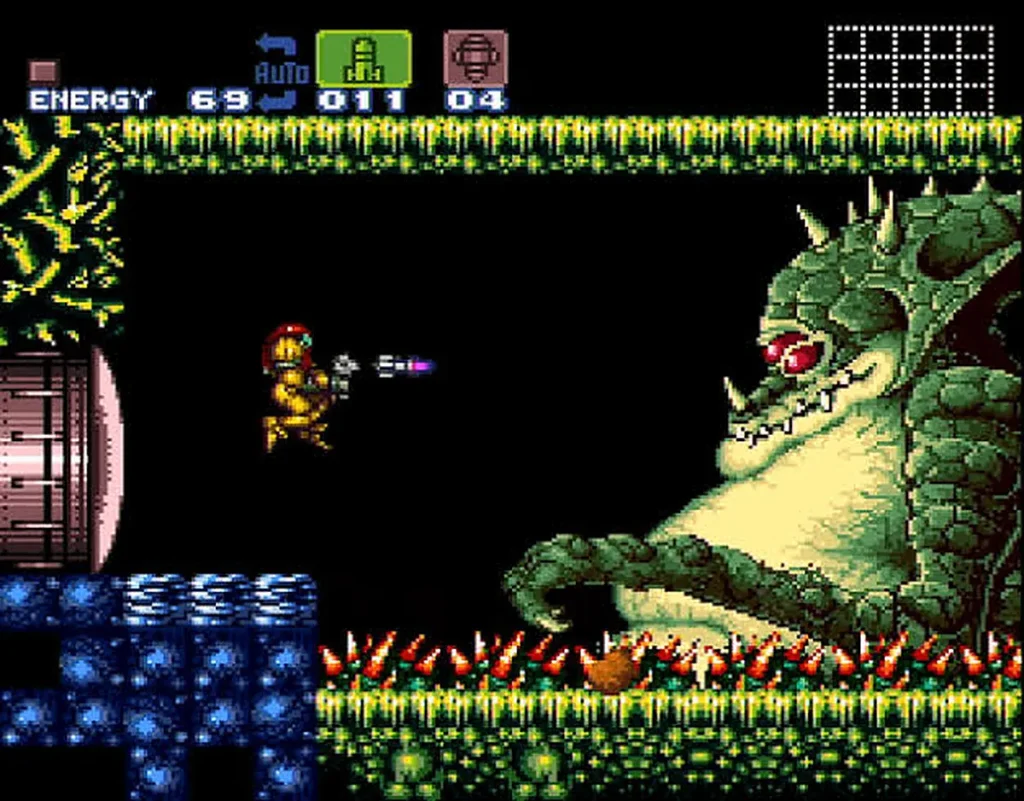
Each of the main bosses, Kraid, Phantoon, Draygon, and Ridley, guards a separate area, and each battle has its own rhythm. In the NES original, Kraid was a minor antagonist; now he takes up two screens. Phantoon is a ghostly boss that blinks in and out of sight between attacks, and it’s frightening in a manner that few 16-bit boss fights are.
Overall difficulty is medium. Energy and missile tanks hidden across Zebes make Samus much tougher, so players who explore have an easier time than those who rush. Save stations are scattered throughout the landscape, and saving at your gunship also restores energy.
Graphics and Atmosphere
Super Metroid showcases the SNES. Rain falls across Crateria, and heat shimmers above Norfair’s lava. Enemies and bosses are huge and detailed, and Samus herself is animated with real weight, from her landings to her turns.
The art direction has held up better than raw technical accomplishments generally do. Every region gets a distinct palette and feel, and the pixel art is sharp enough to read at a glance on a modern screen. Above all, the empty passageways make you feel like the sole friendly face on Zebes.
Music and Sound Design
The soundtrack prioritizes mood over tune. Some tracks are massive and distinctive, particularly the somber themes for Norfair and the boss battles. Others are barely music at all, low drones and ambient noise that create tense soundscapes. The silences are just as purposeful.
Story and Environmental Storytelling
Once the game begins, Super Metroid tells its story almost entirely through locales and events. Ancient buildings and ruined monuments suggest the Chozo, the long-gone race that raised Samus. The Wrecked Ship just lies there, dead, until you beat the boss inside and its systems come back to life around you. There are no dialogue boxes and very little text.
The best example of this is the ending. The closing sequence, without giving anything away, pays off the opening scene with no words at all, and it lands exactly because it never stops to explain itself.
What Has Aged Well
The structure is the obvious answer. Super Metroid helped establish the exploration-centric style commonly dubbed “Metroidvania” — a portmanteau of its name and Castlevania’s. You see that in modern games like Axiom Verge or Ori and the Blind Forest: the same basic idea — a single interconnected world that opens up as you gain new powers.
The tempo is good too. A full run is short by current standards, and its brevity and open structure (which allows sequence breaking) have made it one of the most popular speedrun games for decades.
What Has Not Aged So Well
The controls are the toughest challenge. Running is a held button (default A), cycling through missiles, Super Missiles, Power Bombs, and the Grapple Beam is Select, and the wall jump has strict timing. It’s all learnable, and the options menu lets you remap buttons, but the first hour can feel rigid for players used to modern platformers.
Some secrets also demand a lot from the player. A few essential paths rely on hidden blocks or odd bomb placements, with little in the room to hint at them. Maridia is the common sticking spot, with pathways many players miss.
Is Super Metroid Still Worth Playing Today?
Yes, for most players. It’s a focused game with very little filler, and it’s rewarding in its own right, not just as a history lesson.
Newcomers also get help that 1994 players never had. The game’s official home today is the Super Nintendo Entertainment System – Nintendo Switch Online collection, which requires a Nintendo Switch Online membership and adds a rewind feature that softens the hardest moments. The original cartridge and the 2017 SNES Classic Edition are other legal options. You can no longer buy the Wii U and 3DS Virtual Console versions because those stores closed in 2023.
Final Verdict
Super Metroid earns its reputation through design, not nostalgia. Every region, upgrade, and boss serves one goal: making Zebes feel like a single, real place worth learning. That kind of cohesion is rare in any era.
Play it if you enjoy exploration and atmosphere. Look elsewhere if you need clear objectives and on-screen markers. For more classics, read our reviews of Super Mario 64, Ocarina of Time and Pokémon FireRed.
Super Metroid FAQ
Do I need to play the earlier Metroid games before Super Metroid?
No, Super Metroid begins with a brief narrated summary of Samus’ previous two adventures, then tells its own tale. You don’t need to play the original Metroid or Metroid II first, but some context helps.
How long does it take to beat Super Metroid?
A first playthrough usually takes several hours, depending on how much you explore and how often you get stuck. The game features three endings based on your clear time. You get the best ending by beating the game in under three hours, which seems like a reasonable objective for a second playthrough.
What should I play after Super Metroid?
Metroid Fusion (Game Boy Advance, 2002) picks up where Super Metroid left off, while Metroid Dread (Nintendo Switch, 2021) is after Fusion. Fusion is in the Game Boy Advance library for Nintendo Switch Online + Expansion Pack members, and Metroid: Zero Mission, a remake of the first game, is also available there.